Mercedes Wheel Bearing Noise
Close-up of a Mercedes-Benz wheel and brake assembly
There it is again. A low humming noise somewhere beneath your Mercedes, and it seems to climb whenever your speed does.
On some stretches of road, it all but disappears. Then the surface changes, and the sound is back.
You’ve started second-guessing yourself. Is it the tyres? Is it something worse? Because it’s louder now than when you first noticed it.
And that’s when the bigger questions arrive. What’s this going to cost? Is the car safe to keep driving?
So what could be making the sound? A worn wheel bearing is one of several possible explanations for a humming or droning noise that grows with speed.
A humming or droning noise from a Mercedes that climbs with speed, and can shift as the car steers through bends, is widely reported as a sign of wheel bearing wear. Most modern Mercedes turn each wheel on a sealed bearing unit so it spins freely. Should a technician confirm the wear, a new bearing is the lasting fix.
Wheel bearings are wear items, just like tyres and brake pads. Given enough time and miles, any car can develop bearing wear, whatever badge it carries, and replacing a confirmed worn bearing is well within the capability of our Mercedes technicians.
In the sections ahead, we’ll cover what a Mercedes wheel bearing noise could mean, why it’s so easy to blame the tyres, what leaving it can lead to, and how our technicians identify the cause and carry out the correct repair.
What Could Be Creating That Humming Sound in Your Mercedes?

Black Mercedes-Benz saloon driving at speed
More than one part of your Mercedes can produce a humming noise, and we’ll come to the alternatives shortly. When the sound rises with your speed, though, a worn wheel bearing is one of the widely reported causes.
What does a wheel bearing do, then? And how does wear become something you can hear?
Most modern Mercedes models mount each wheel on a sealed wheel bearing. The bearing allows the wheel to turn freely with minimal friction while supporting the car’s weight and handling the loads from braking and cornering. When the bearing’s healthy, that work goes on quietly in the background.
Wear changes things. Tiny imperfections can develop inside the bearing, and they’re what create the humming or droning noise you hear on the move. As your car speed rises, that wear can become easier to hear, which is why a Mercedes humming noise when driving can grow with speed.
Driving around bends can alter the sound too. Steer through a corner, and more of the car’s weight shifts onto one side, and a worn bearing on that side can become louder under the extra load.
Time and mileage are what wear wheel bearings down, with water, road grit and repeated hits from potholes and kerbs among the factors that speed the process up.
Which raises the obvious question: is it the wheel bearing at all, or just your tyres?
Tyre Noise or Wheel Bearing Noise: Which Are You Hearing?
Close-up of a Mercedes-Benz alloy wheel
Here’s the tricky part… Worn tyres can drone at speed too, and so can a handful of other components under the car, which is why this humming or droning noise is such an easy one to misread.
There are clues that can separate the two, though.
Cornering behaviour is one of the more useful clues. Tyre noise largely follows road speed and surface, and cornering tends not to move it. Bearing wear can respond to load: one bend can raise the sound while the opposite bend can quieten it.
And tyres aren’t the end of the list. Uneven tyre wear, certain brake faults and some drive shaft (CV joint) faults can create similar sounds, and each may need ruling out during diagnosis.
So if you’ve caught yourself searching, “Why is my Mercedes making a droning noise?”, here’s the honest position: a description alone won’t confirm it for certain.
The cause shows itself on a road test, where the noise is heard first-hand, and in the careful assessment of the wheels and surrounding components that follows. Our experts at JDK Automotive, Camberley, handle both for you.
Pinning Down Mercedes Wheel Bearing Noise for Camberley Drivers
At JDK Automotive, Camberley, our experts start every investigation with a conversation. Our Mercedes technicians will ask you questions such as:
- What have you noticed while driving?
- When did the humming noise first appear?
- Does the sound change with road speed, or through corners?
- And others…
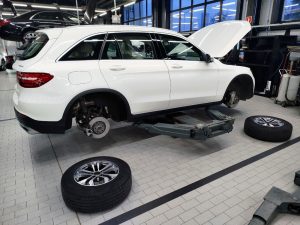
Mercedes-Benz SUV with its wheels removed
Your answers are crucial to our initial investigation because they help point our technicians in the right direction.
From there, our experts will normally take the car on a controlled test drive to experience the noise first-hand.
The car is then raised so our technicians can assess each wheel by hand, looking for the signs that can indicate a worn wheel bearing. They combine years of experience with dealer-level information for your exact model, because the noise alone won’t confirm the cause or which bearing has worn.
Bearing wear can occur across the Mercedes range, including models like the C-Class, E-Class, A-Class, GLC, GLA, CLA, and others.
And because wheel bearings are wear items on every car, any Mercedes can develop the issue, whatever its age or engine type.
Not sure whether you’re hearing a Mercedes wheel bearing noise or something else?
Our experts at JDK Automotive, Camberley, can assess the car, explain exactly what they find, and agree on the appropriate repair with you before any work is carried out.
Can You Ignore a Worn Wheel Bearing Safely?
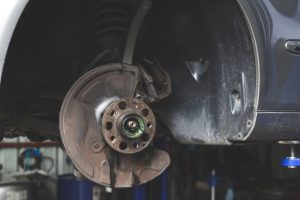
Wheel hub area on an unidentified vehicle
Suppose you turn the radio up so you can’t hear the noise and carry on driving. What then?
Unfortunately, a worn wheel bearing is likely to get worse over time.
As the wear deepens, a worn wheel bearing can:
- Allow excessive play to develop at the wheel, changing how the car drives and handles.
- Contribute to your tyres wearing unevenly.
- Lead to damage to nearby components if it’s left unchecked.
In severe cases, a badly worn bearing can overheat or even seize. Leave it that long, and the hub and other surrounding components can be damaged as well, so what began as one worn bearing can become a larger (and more expensive) repair.
That’s why a humming or droning noise that keeps growing is worth an expert’s attention now rather than later.
There’s also your MOT to consider here. Wheel bearing wear is one of the things an MOT tester assesses, and a bearing with excessive play can be classed as a major or dangerous defect, which means a failed MOT.
The good news is that catching the wear early can help protect the components around the bearing from further damage. If that noise has been building for a while, it’s worth letting our experts at JDK Automotive, Camberley, take a look.
How We Fit a Replacement Wheel Bearing to Your Mercedes
On most modern Mercedes, wheel bearings arrive as sealed units. Repairing one isn’t part of the design, so confirmed wear means our expert technicians remove the complete unit and fit a new one in its place.
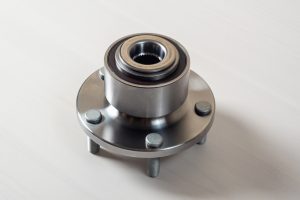
Generic example of a wheel hub and bearing assembly
A Mercedes wheel bearing replacement normally involves three main stages:
- Confirmation first: our experts use a road test and hands-on checks to establish which wheel bearing has worn.
- Our technicians then remove the old unit, fit the replacement that matches your model, and tighten it to the manufacturer’s stated specification.
- A final road test lets our technicians confirm the noise has gone and everything behaves as it should on the road.
Our experts bring Mercedes experience and manufacturer-level technical data for your exact model to the job, repairing it in line with manufacturer guidelines.
Whether the job is a Mercedes C-Class wheel bearing replacement or the same repair on an E-Class, a GLC or another model, the stages follow the same general pattern. However, the exact procedure and the specifications involved can differ from one Mercedes model to another.
What matters most is that the cause of the noise has been correctly identified, the new bearing has been fitted correctly, and the repair has been verified afterwards. That’s why it pays to hand the work to an expert team that knows the Mercedes range.
Why Choose JDK Automotive, Camberley, for Mercedes Wheel Bearing Repairs
Our experts spend their days confirming exactly what’s behind a sound like a Mercedes wheel bearing noise.
Because a humming or droning noise that builds with speed can be misread so easily, guesswork gets expensive. An assessment from technicians with Mercedes-wide experience gives you the real cause, and spares you paying out for parts that weren’t at fault.
Hands-on experience comes first at JDK Automotive, Camberley; manufacturer-level information and technology for your model back it up. That combination enables our expert technicians to accurately identify the cause and perform the correct repair.
By choosing JDK Automotive, you benefit from:
- Experienced Mercedes technicians using dealer-level information and equipment.
- A 12-month parts and labour guarantee on repairs.
- A team trusted by Mercedes owners across Camberley and Farnborough.
- Honest recommendations based on what your car actually needs.
Join the {{review-count}} drivers around Camberley and Farnborough who’ve handed JDK Automotive a {{average-rating}}-star Google rating for accurate repairs, honest guidance and great value for money.
From a Mercedes C-Class wheel bearing replacement to the same care for an E-Class, a GLC or any other model in the range, we can find the source of the noise and put it right.
When you’re ready, call our Mercedes experts at JDK Automotive, Camberley, on 01276 535585; we’ll book your wheel bearing assessment and get your Mercedes running the way it should.
Call Now 01276 535585Save on Mercedes Servicing
Frequently Asked Questions
Is a Mercedes humming noise when driving serious?
A Mercedes humming noise when driving deserves attention. Several parts can produce it, and wheel bearing wear is a widely reported source. Allowed to continue, that wear can bring excessive play at the wheel and a change in how the car behaves on the road. Call our experts at JDK Automotive, Camberley, for a clear answer and an agreed repair.
Will a worn wheel bearing fail my MOT?
Yes, if the wear has gone far enough. Wheel bearings are part of what the MOT tester examines; excessive play or roughness found at a bearing can be graded as a major or dangerous defect, and that grade means a fail. Getting the bearing seen to ahead of the test can help you avoid it.
Do both wheel bearings need replacing at the same time?
No, not always. Our technicians replace the bearing that’s worn rather than parts that still have life in them. If the bearing on the opposite side is showing its age, they may suggest doing the pair, but you’ll know exactly what’s needed and why, before anything goes ahead. If you’re unsure, call JDK Automotive, Camberley, and we’ll take a look.
Why is my Mercedes making a droning noise?
A droning noise that rises with speed can have more than one source. Wheel bearing wear sits alongside tyres, certain brake faults and some drive shaft (CV joint) faults on the list of widely reported causes. An inspection by an expert technician is what gives you a definite answer.
What does a Mercedes wheel bearing replacement involve?
Confirming the worn bearing comes first in a Mercedes wheel bearing replacement. From there, our technicians fit a complete sealed replacement unit and torque it to the specification Mercedes sets for the model, finishing with a road test to be sure the noise has gone. Book your wheel bearing assessment with JDK Automotive, Camberley, today.